
Introduction
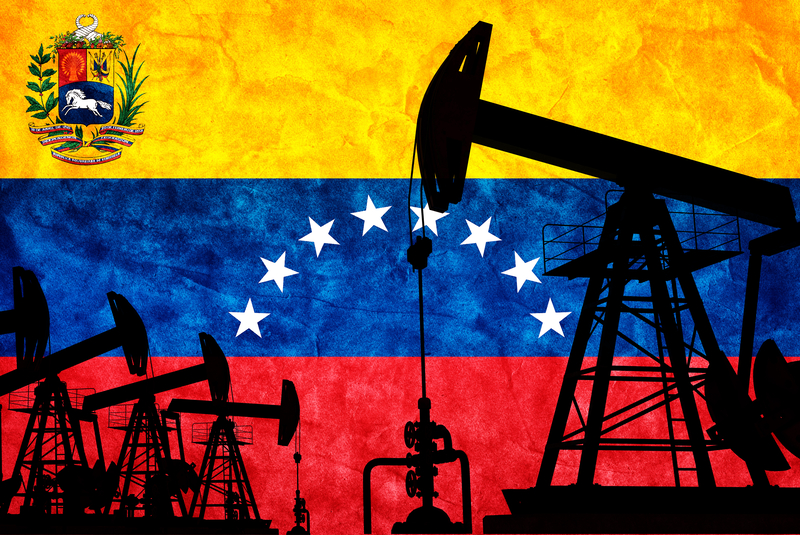
Venezuela is the country with the largest oil reserves in the world, estimated at around 303 billion barrels in 2023, and this has always made it a strategic target for international powers. However, the issue is far more complex as it involves multiple geopolitical and economic factors. The question this article aims to answer is therefore: How do recent political and oil-sector developments in Venezuela reshape the country’s resource curse dynamics?
Historical Context of Venezuela’s Oil Sector
First, it is fundamental to provide some historical context, as Venezuela’s oil history is not recent. At the beginning of the twentieth century, oil extraction expanded rapidly, particularly in the Maracaibo area, where oil was easier to extract than the heavier crude found in the Orinoco Belt. Production grew in the following years, also due to the presence of several international companies operating in the country. During the 1970s, production reached approximately 3.5 million barrels per day, and in 1975, a major turning point occurred with the foundation of PDVSA (Petróleos de Venezuela, S.A.), the state-owned oil company. PDVSA soon became one of the most prestigious oil companies in the world due to its technical expertise and advanced technologies.
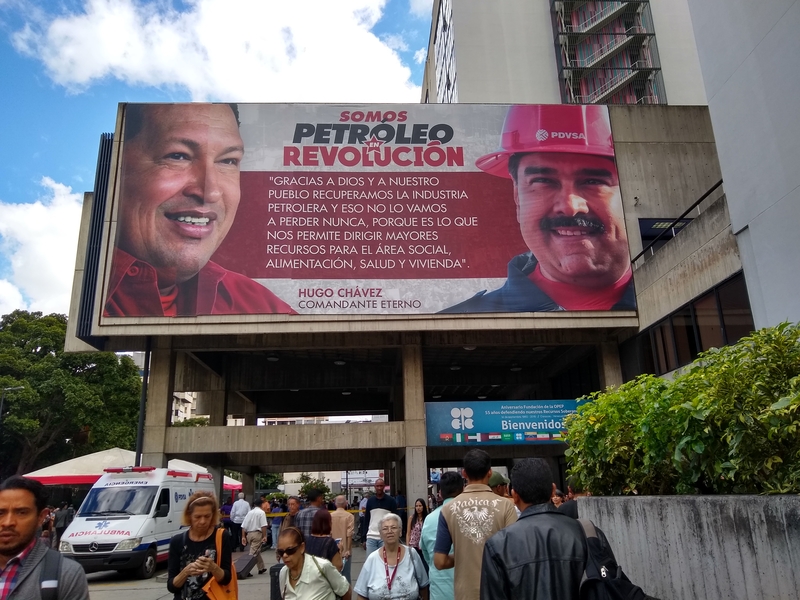
Another crucial turning point occurred in 2007, under President Hugo Chávez, who fully nationalised production in the Orinoco Belt, an area where international companies had previously operated. Through the controversial geopolitical operation known as Plena Soberanía Petrolera, companies were required either to reduce their ownership shares or to leave the country altogether. However, due to the lack of domestic expertise and technology required for extraction in the region, joint ventures were allowed, leaving foreign companies with 40% ownership stakes.
Some companies, such as ExxonMobil and ConocoPhillips, rejected the agreement and sued Venezuela for illegal expropriation. Others, including Chevron, Repsol, Eni, Total, Statoil, and BP, accepted the new terms but significantly reduced their activities and investments. While this process was symbolically presented as an act of emancipation, from an industrial perspective, it marked the beginning of a decline. Production progressively decreased, eventually falling below one million barrels per day, due to the loss of technical expertise, declining investment, and growing mistrust among remaining operators.
Recent Developments
Following the recent arrest of Nicolás Maduro on charges of drug trafficking in the United States and the interim appointment of President Delcy Rodríguez, the U.S. announced its intention to collaborate with the new government in managing Venezuela’s oil reserves. On 9 January, the U.S. president met with representatives of the world’s major oil companies and stated that negotiations would be conducted directly with Washington rather than Caracas, and that the U.S. would decide which companies would be allowed to operate in Venezuela. The president also suggested that expected investments could reach $100 billion.
However, doubts and uncertainties among oil companies remain significant due to Venezuela’s political instability and deteriorated infrastructure. As ExxonMobil’s CEO stated, previous asset seizures have made re-entry highly conditional on substantial changes in the country’s legal and institutional framework. Although negotiations are still ongoing, the meeting confirmed the centrality of Venezuelan oil as a strategic priority in U.S.–Venezuela relations.
The resource curse
Alongside the historical and current context, this article aims to provide an insightful perspective on whether recent changes in the management of oil resources will benefit the country or instead reinforce pre-existing mechanisms that have penalized both the economy and its citizens. To properly understand this issue, it is necessary to introduce the concept of the resource curse and its main explanations.
The resource curse is an economic paradox occurring in countries where valuable natural resources are concentrated and which tended to experience slower long-term economic growth, greater macroeconomic volatility, and weaker institutional development than resource-poor countries.
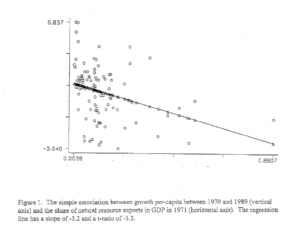
Scholars have sought to explain this paradox by focusing primarily on two mechanisms: the Dutch disease and the role of institutions. The former refers to an economic mechanism in which a resource boom leads to real exchange rate appreciation, undermining the competitiveness of non-resource tradable sectors and resulting in their relative decline and increased dependence on the booming resource sector. The latter relates to the fact that where political power is unchecked and information is opaque, resource rents tend to corrupt governance, distort economic incentives, and fuel conflict.
Venezuelan Context
These theoretical mechanisms can be clearly observed in the Venezuelan case, where both Dutch disease dynamics and institutional weaknesses have played a central role in shaping economic outcomes. As shown by Márquez-Velázquez (2019), Venezuela’s dependence on oil revenues has interacted closely with political cycles, particularly during periods of high oil prices. In such phases, governments tended to expand public spending and investment in highly visible projects aimed at consolidating political support, rather than saving windfall revenues or promoting long-term economic diversification.
This pattern reinforced the structural features of the resource curse. On the one hand, Dutch disease effects contributed to the progressive decline of non-oil tradable sectors, increasing the economy’s reliance on oil exports. On the other hand, weak institutional constraints and limited transparency allowed oil rents to be used in a discretionary manner, distorting economic incentives and reducing fiscal discipline. As a result, Venezuela became increasingly vulnerable to external shocks linked to oil price fluctuations.
These vulnerabilities have had important macroeconomic consequences, particularly in terms of inflation. Building on this framework, Su et al. (2020) show that oil price volatility, especially when combined with high geopolitical risk, has been a significant driver of inflation in Venezuela. Their findings indicate that the transmission of oil shocks to domestic prices operates both in the short and long run, suggesting that the resource curse in Venezuela manifests not only through growth and institutional channels, but also through persistent inflationary pressures that directly affect economic stability and citizens’ welfare.
Conclusion
Recent developments in Venezuela’s oil sector, including regulatory reforms and renewed engagement with international partners over the past month, underscore the critical role that institutions will play in determining the country’s future trajectory. While increased foreign involvement and improved access to international markets may offer short-term economic relief, these changes also risk reinforcing existing resource-dependent dynamics if not accompanied by strong institutional safeguards. In this context, the sustainability of the current transition depends less on the volume of oil revenues generated than on the capacity of Venezuelan institutions to manage those revenues transparently and in the public interest.
If institutional constraints remain weak, oil risks continuing to function as a political instrument used to secure external alliances or short-term political stability rather than as a foundation for broad-based development. Prioritizing relational interests with external actors, including the U.S., without parallel efforts to strengthen accountability, fiscal discipline, and domestic legitimacy may reproduce the very mechanisms that have historically penalized Venezuelan society. Ultimately, for Venezuela to move beyond the resource curse, oil revenues must be channeled toward inclusive economic outcomes and social welfare, ensuring that natural resources serve the population as a whole rather than the strategic interests of political elites.
References
Márquez-Velázquez, Alejandro, 2019. “Developing countries’ political cycles and the resource curse: Venezuela’s case,” Discussion Papers 2019/14, Free University Berlin, School of Business & Economics.
Su, Chi-Wei & Khan, Khalid & Tao, Ran & Umar, Muhammad, 2020. “A review of resource curse burden on inflation in Venezuela,” Energy, Elsevier, vol. 204(C).