
Sitting outdoors at a café in Hanoi, motorbikes streaming past me and the air thick with the sweet, dry scent of coffee and spring humidity, I felt like I was living an alternate reality. The scene mirrored my everyday in San Francisco: sitting outside Café Réveille, watching cars pass slowly by as the fog rolls in. But in Hanoi, my presence felt different. Though it matched my life in many ways, it was clear that it was a divergent reality that had long passed its ability to pan out.
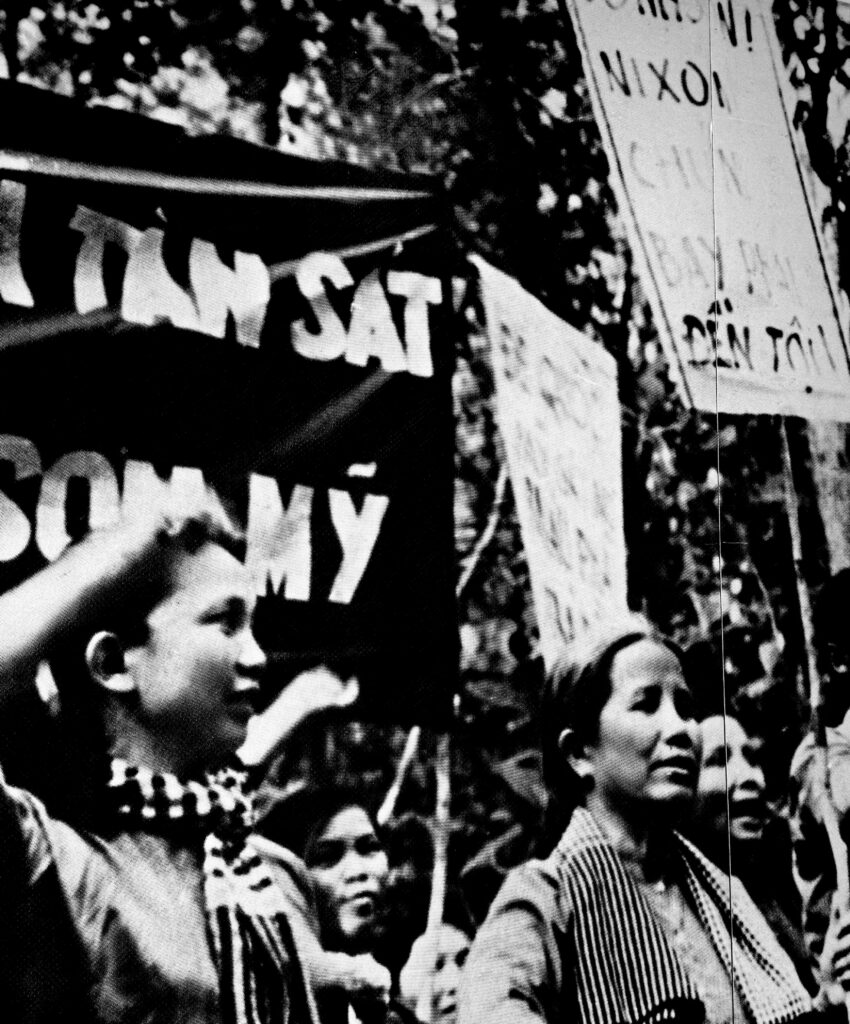
Rather than feeling at home in my family’s country of origin, I could feel the effects of the migratory diaspora weighing on me. Just over 50 years since both U.S. troops and my family left Vietnam in 1973 and 1974, respectively, the Vietnam I sat in was far from the one I had imagined. Even through the first-hand perspective of my family’s stories, I am ashamed to admit that my image of the country—like that of many Americans—was one rooted in the past. Yet, rather than upholding the undeveloped, second-world image often reinforced through U.S. memory, Vietnam today is defined by rapid development, modernization, and a continuously thriving culture. After centuries of domination—first by China from 111 BC to 938 AD, France from 1858 to 1954 then the U.S. from 1965 to 1973—it is a country flourishing on its own terms.
At the same time, halfway across the world, another war was unfolding. As I sat in a booming Vietnam with plastic-table-lined sidewalks beneath a growing skyline, I watched the beginnings of another conflict emerge in Iran. A major armed conflict involving the U.S., Iran and Israel erupted after months of escalating tensions over regional militias and missile exchanges. U.S. and Israeli forces have launched strikes on Iranian military infrastructure, while Iran has retaliated with attacks on both American bases and Israeli cities. As of April 2026, more than 3,300 people have been killed and millions displaced.
The overlap was difficult to ignore.
As the conflict unfolds, Iranian officials have issued a familiar warning. Iran’s deputy foreign minister Saeed Khatibzadeh cautioned that the U.S. risks “another Vietnam” if it decides to deploy troops, implying overcommitting to a prolonged confrontation. “They understand those that dragged them into this war can drag them also into a quagmire,” Khatibzadeh said.
Though Vietnam and Iran’s conflicts are fundamentally very different—Vietnam emerged from decades of anti-colonial struggle and internal division, while the current Iran conflict stems from regional power tensions and disputes over military and nuclear capabilities—journalist Scott Strgacich additionally pointed out similarities in the early stages of U.S. involvement in an oped for The National Interest. “While the Iran War is often compared to the Iraq War, it could more closely resemble the botched US entry into the Vietnam War,” he said.
For decades, phrases like “Lessons of Vietnam” and “No More Vietnams” have shaped how Americans think about and approach foreign intervention. But these lessons are often narrowly defined. In the U.S., Vietnam is remembered primarily as a military failure, a war of overcommitment that ended in loss. Even language reflects this reduction: for many Americans, “Vietnam” refers to the war itself, while “Tet” evokes memories of the Tet Offensive, rather than its true meaning of Lunar New Year, the country’s most celebratory holiday. “Vietnam became a shorthand for the Vietnam War—reducing a country to a single conflict that involved the US,” Jeffrey Ngo, a Doctoral Student at Georgetown University, said.
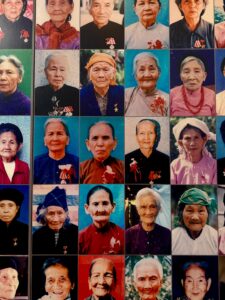
This is a problem: when countries become defined by conflict—not just Vietnam, but also Iraq, Afghanistan, or the Latin American nations impacted by the US during the Cold War—the histories, culture and people within them are reduced as well, their lives overshadowed by narratives of failure or underdevelopment. Put simply by my aunt, Mini Le, “What about the people?” This polarizing image not only shapes perception but generational identity.
However, there are more meaningful ways to apply the “Lessons of Vietnam.”
Reducing nations to their politics
In referring to the war in Iran, President Trump said on CNBC’s Squawk Box, “I would have won Vietnam very quickly if I were president.” But understanding Vietnam’s history means recognizing that it was a country gasping for independence after being buried beneath the influence of major groups in power for centuries. According to Mike Clayton, Lick-Wilmerding High School U.S. History and War Literature senior seminar teacher, “What will enable the most autonomy and success seems to have actually been more of the driving factor in [the Vietnam War] than just communism versus capitalism,” he said. Vietnam was not simply a battlefield, but a country struggling to define itself after centuries of both external and internal pressures.
As my mother, Minou Le, said: “It’s like that analogy of the lotus flower. For them, the American War was probably just another chapter of that pattern of outside forces trying to dominate them, and they continue to rise out of that.”
The U.S. has long framed Vietnam as a failure, but that perspective overlooks the reality that the end of the war also marked a form of national independence. While the war was fought around political ideologies—namely, communism versus capitalism—for many Vietnamese and for the diaspora, it also represented a major form of unification. “It’s a big gain for Vietnam to unify the country. It’s never been unified before. Now, people can go from the south to the north freely,” my grandma said. Vietnam had been divided for years, and while the outcome signaled a loss for the U.S., it allowed the country to begin evolving on its own terms.
“Understand the South Vietnamese rebuilding project as serious aspirations from a group of people who wanted to build their own nation,” Ngo said. “What is called the fall of Saigon is called the liberation of Ho Chi Minh City.”
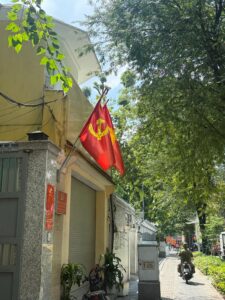
Today, the Vietnam I have come to know stands as a country of undeniable progress.
Poverty has dropped from over 50% in the early 1990s to under 5% by 2020. With an annual per capita income of about $1,000 in 2008, Vietnam was removed from the list of the world’s least developed countries. Out of a population of roughly 102 million, about 38.2% to 40.2% now live in urban areas, reflecting both rapid development and ongoing transformation. Most of all, areas impaired by the war have been able to sustain against the backdrop of modern development, keeping aspects of Vietnam’s traditional essence alive.
“It just make me feel happy that is better now than when I lived there. I still see the same lake and the area that are familiar with me…my home is still there,” my grandma, Kim Le, said.
“Vietnam” presents a lesson for Americans in many ways. While it is often framed as a lesson in military strategy and foreign policy, it is also a lesson in the dangers of reducing nations to a single conflict. Doing so flattens entire countries into symbols of war while overlooking their histories and contributions.
But beneath the surface lies another, more lasting consequence: the enduring effects these conflicts have on diaspora communities across generations.
The effects of war on the diaspora
After the Vietnam War, millions of civilians were displaced, many resettling in the U.S. For both those who left and those who stayed, the war did not end. While today, around 70% to 75% of both the U.S. and Vietnamese populations were born after the Vietnam War, the conflict continues to reshape identity and belonging across generations. For my family, like many others, the war split lives across continents, and these effects still ring across our lineage.
In the U.S., even though immigration is certainly received as a major gift of survival and opportunity, what’s often overlooked is how it can create a quieter battle for immigrants in navigating isolation while being severed from both their homeland and their community.
When my family immigrated, they settled in Saint Paul, Minnesota, a community that was welcoming, yet presented a maze of assimilation and cultural norms that were difficult to navigate. “The technique, the strategy that Mom and Dad had, was not to stand out, because when they grew up in Vietnam, standing out could cost you your life,” my mother said, reflecting on her experience growing up in an all-American community. Meanwhile, as my family evolved through their new life in the US, Vietnam became frozen in memory. Even until now.
“Mom and dad were sort of stuck in the old image 40 years ago… their memory of their homeland is frozen in time, in amber. They don’t see that there’s been so many changes since then,” my mother said.
Returning only complicates that relationship. During our recent visit, for my mom and aunt, Mini Le, certain Vietnamese foods or phrases would elicit entire memories of their lives in Vietnam. “When you don’t remember anything from your own memory, then there’s no connection to feeling like, ‘I’m returning to my homeland.’ But at the same time, there’s familiarity… the dishes we eat from Mom’s kitchen are everywhere,” my aunt said. “Even though, obviously, we’re very different, just because we are both Vietnamese, I felt connected to them,” my mom added.
However, as separation from the home country goes further down the line, this intuitive connection slowly shrinks. For me, the country reminds me of my mother and grandmother and cherished family stories, but not of a place I truly know. Instead of belonging, I visited Vietnam from an emotional distance—rather than connecting to my roots, I feel more detached from my identity. There is a sense of connection and disconnection at once, an identity shaped as much by absence as by heritage.
Moreover, returning made the separation of my family lineage feel even more expansive. A mix of joy and heaviness when reconnecting with relatives, the emotional weight of realizing how much time we have spent living divided lives was deeply felt.
“It was a combination of not feeling very American and not feeling complete with the people there. Then, feeling a little bit of guilt because I’ve lived more outside of Vietnam, so I can’t expect myself to feel like it was when I was five,” my aunt said.
Within Vietnam, the war is largely framed as a national ‘win.’ Yet, while the country is dotted with buildings named “Victory Hotel” or “Victory Café,” the conflict was never a simple triumph.
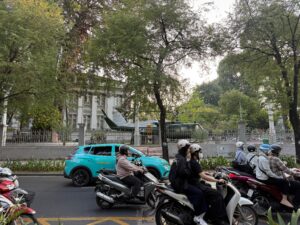
“As a Vietnamese, we were engraved that the war had destroyed more things than only facilities, but tearing families and people apart. We mourn for the lost and learn the lesson that independence and peace can restore our life,” my second-cousin, Kim Ahn, said. “We are happy to be independent, yet we pay an enormous price of lives, people and the natural landscape.”
The consequences of war are also still visible in Vietnam today. From the lasting effects of Agent Orange to unexploded bombs buried beneath the ground, the damage continues decades later. The bombs still buried beneath the soil represent repercussions of the war on civilians still waiting to go off, remnants of pain and violence that have yet to fully surface.
International aid versus international subjugation
Iran does not share Vietnam’s exact history of colonization, but it has long endured competing spheres of foreign influence, from British and Russian imperial pressure to repeated U.S. political involvement during the Cold War. With warnings of “another Vietnam,” the conflict in Iran raises the question of whether Iran, like Vietnam, will ever be able to exist in the global imagination beyond its political background, and whether it can define itself on its own terms.
As someone shaped by the lasting effects of war and diaspora, my grandma offers some advice: “I think every country have their own right to live as they want,” she said.
Sitting in that café in Hanoi, I thought about the life I might have lived had my family never left. But more than that, I reflected on my path getting there—illustrating what it takes for communities shaped by war to endure, and eventually, return. As a young person shaped by the diaspora effects of the Vietnam War, I wish that foreign policy recognized when the goal is to win, versus when the goal is to truly help.